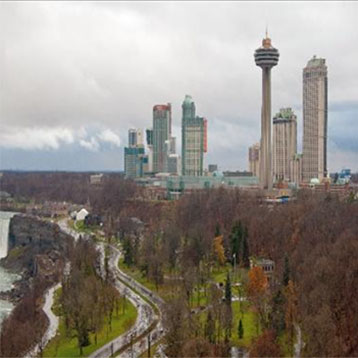
The skyline of a city is very different than the horizon of a forest.
Hmmm. Differences between the two bugged me for a long time until I formulated thoughts about them.
In the forests that I experience, mostly in upstate New York, trees have a relative uniformity of height (an exception being an internet booster disguised as a phony treepole). I view the horizon, and after appreciating the story that the skies are sharing (sometimes antics, sometimes serenity, sometimes drama, sometimes amusement, sometimes wispy yearning), my eyes are drawn to the tree line below.
The seven-year-old in me then opens up with questions. Why are all the trees about the same height? Why are they that height and not taller and not shorter? How can they grow so close together? Are they comfortable or crowded? Because trees, unlike structures in a city, are not human-made, I cannot ask their creator about design decisions guiding the development of the forest.
I know more about the structures in cities. Cities are not organic, so they do not breathe, extend roots into the earth that communicate with other tree roots, or grow larger over time without human aid. But there are similarities between the ‘development’ of a forest and the ‘history’ of a city. Forests have dense vegetative undergrowth while cities have dense people undergrowth. Communication channels between trees are largely under the soil while communication channels across buildings exist in tunnels, subways, streets, and internet connections. One species of tree – or building – replaces another when it is stronger and better able to reach the source of sunlight – or finance. Time takes its toll in both realms and only the most deeply rooted in either a terrain or a culture will survive the centuries.
If you will, the city is the ‘human forest’. But… a city has skyscrapers, and a forest does not.

 Worth Developing