I want to start a movement that magnifies the mundane. The best short story writers demonstrate the essence of the inconsequential. Their gifts for showing how one small event transforms a relationship can be moving and even life-adjusting. Shakespeare warns us that the loss of a horseshoe could lead to the loss of a battle. System Scientists predict that the fluttering of a butterfly’s wing in Asia can influence the winds across North America. Derrida helps us see that it is a minor aspect of the dominant culture that may manifest as the next massive movement for change. (Who would have predicted the growth of the minor sect of Christianity from a corner of the Roman Empire? Or the omnipresence of the internet from the small successes of a few computer nerds?)
The small is significant from one view, but not from another. Scale is what makes the difference. That tiny bright spot in the sky is a huge star, as we know. The small action is awesome in that moment of time it fills. Mother Teresa transformed a life by offering gentle care at the moment of dying. A poorly paid institutional assistant can make a difference in a baby’s life by changing that infant’s diaper with an affectionate gaze and a loving touch. The most poorly paid among us may make the greatest difference in a particular life.
Frankly, I get tired of other people telling me what is important. Don’t you! I know that giving direction to others is one of my stronger skills, but then, it is just for their own good. Right? (smile). But what I am talking about is the elevation of important things over trivial things. If small actions are done ‘right’ then a pattern is set to also perform large actions in the ‘right way’. It is not an accident that so many traditions focus on rituals in religious practice. It IS sacred to do a small thing ‘just right’. I am reminded of the Karate Kid carefully waxing the car, first with irritation and later with the focus that comes from meditative training.
Frequently it is female tasks that are seen as trivial. If actions are performed by males, they are seen as more difficult or challenging than similar tasks performed by a woman. I recall the sociological study presented in “The Cocktail Waitress: Woman’s Work in a Man’s World” (Spradley and Mann, 2008, Waveland Press). The position of the waitress cleaning the dirty ash trays was demeaned whereas the bartender cleaning the dirty glasses was elevated. Hmmm. Was it the difference in the glassware of the difference of the gender that mattered here?
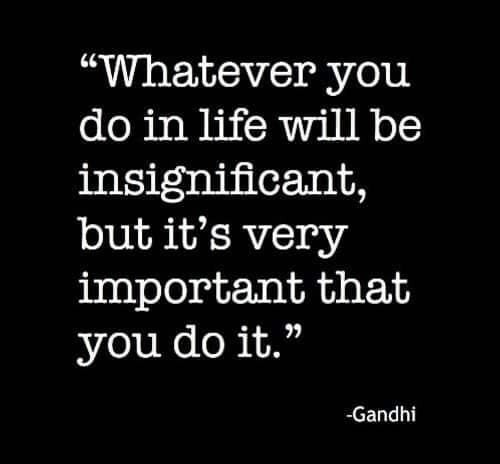
There are so many barriers to our treating each person as a ‘thou’ rather than an ‘it’; to focusing on that seemingly inconsequential task, or to finishing that pointless work. I can’t forget what Ghandhi said: “What you do in life will be insignificant. But it’s very important that you do it”.

 Worth Developing